
Signal Capture Engine
Collects corrections, approvals, rejections, tool outcomes, and missing-context moments across every channel agents and people use.
From action to better.
Live work (corrections, rejections, missing context, tool failures, approvals) becomes evidence and reviewable improvements. Never silent self-modification.
New exceptions appear. Approval paths shift. Tool fields change. Teams find better ways to work. Without continuous learning, you are managing a fixed system inside a moving company, and the gap between platform and reality compounds every week.
The Continuous Learning System keeps the platform alive. It turns real production signals into durable improvements, but only through human approval. Material agent behaviour, tool permissions, and integrations never change silently.
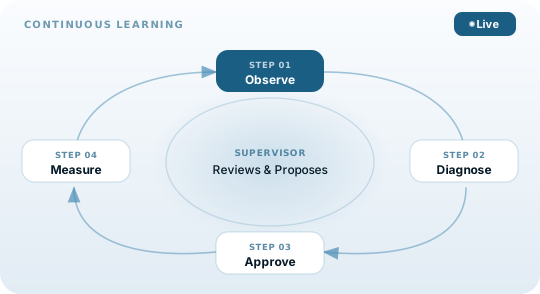
Six steps turn live signals into governed improvements.
Collect corrections, approvals, rejections, tool failures, missing-context moments, and admin notes, across Company GPT, agent teams, and operational channels.
Determine the root cause (missing expertise, stale context, wrong process, routing issue, tool gap) before suggesting any fix.
Automatically capture personal continuity, lightweight context, and operating observations when policy allows, without bothering an admin.
Route expertise, context, process, and guardrail changes to a human approval queue with evidence, diff, expected effect, and rollback plan.
Agent behaviour, tool permissions, integrations, and guardrails need owner approval and a measurement plan before release.
Track before/after improvement, detect regressions, and roll back if needed. Every change has a measurable outcome.
Every improvement is observable, reviewable, and reversible.
Six engines turn live work into governed learning.
Collects corrections, approvals, rejections, tool outcomes, and missing-context moments across every channel agents and people use.
Distinguishes missing expertise from stale context from process drift from tool gaps, and routes each to the right kind of fix.
Verified knowledge does not stay verified by inertia: trust decays as reviews lapse or evidence shifts. The platform only lowers trust on its own; only a human restores it, through Trust Review and the Review hub.
Projected wiki pages re-synthesize as knowledge changes, the Gardener proposes splits, merges, and missing pages, and the contradiction detector flags pages that disagree. Humans approve every proposal.
The Builder Agent reads the accumulated knowledge and proposes configuration improvements as change requests. The autonomy ladder has no auto-apply rung, and a kill switch halts everything unattended.
Tracks before/after metrics, replay drift, and Brain Metrics like brain-to-config latency, detects regressions, enables rollback, and feeds validated learning back into expertise packages.
The feedback cycle that keeps expertise packages and agent behaviour current as your company changes: observe, diagnose, propose, approve, release, measure.
Distinguishes missing expertise from stale context from prompt problems, and routes each to the right solution layer.
Lightweight signals capture automatically; only material production behaviour changes need owner approval and measurement.
Improvements are not complete until effect is measured and rollback plans are ready.
Missing judgment triggers expertise refresh, not a hidden prompt patch nobody can audit later.
Verti connects expert judgment, live context, governed action, and learning loops into one production system.